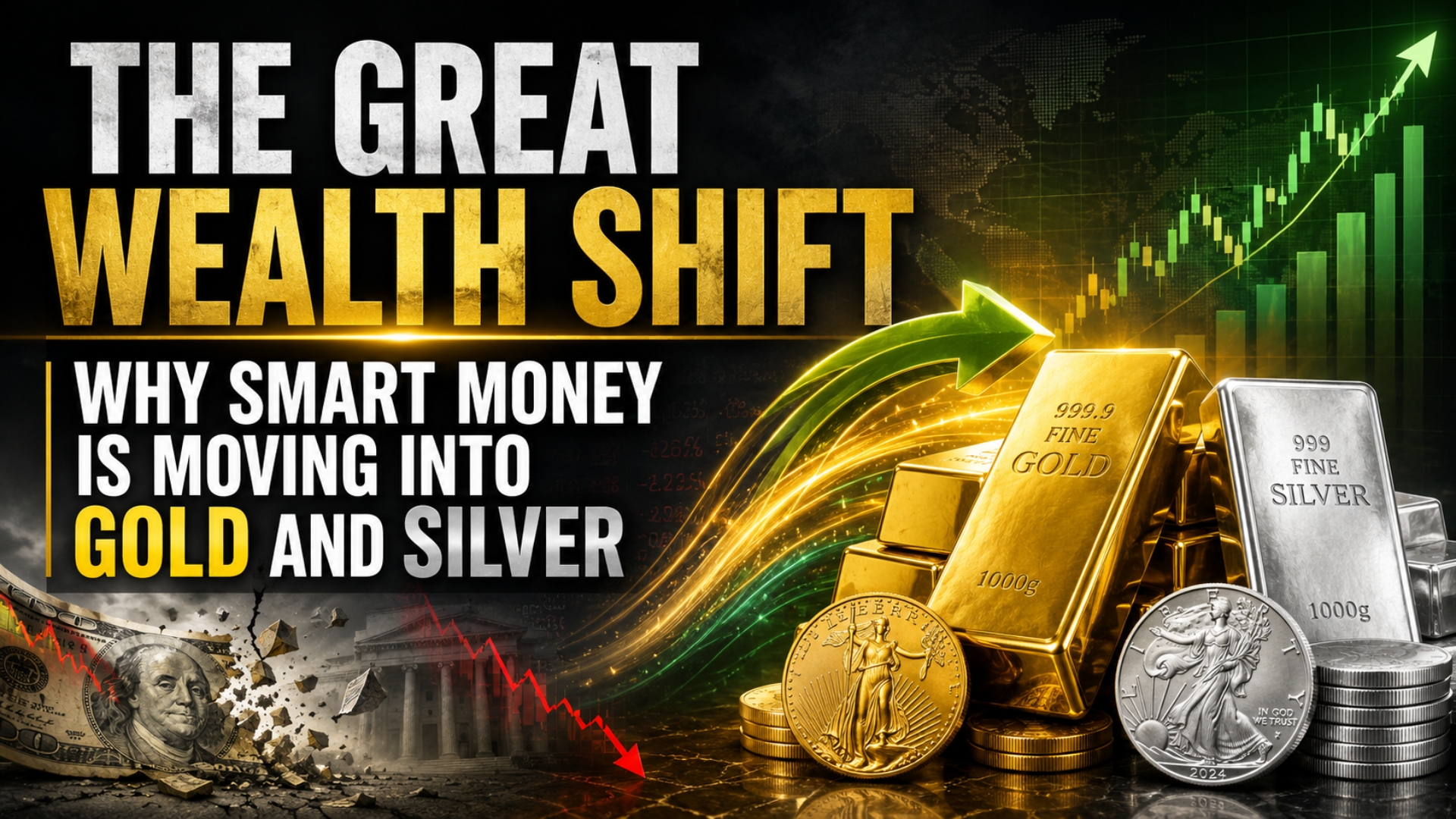
I recently returned from The MoneyShow in Las Vegas, where I spoke about what I believe is one of the most consequential financial developments of our time: a historic transfer of wealth away from paper promises and toward tangible assets.
I call it The Great Wealth Shift.
This is not simply a forecast that gold and silver prices will rise. It is a much larger story involving government debt, persistent deficits, currency creation, central-bank behavior, resource scarcity, technological demand, and the gradual deterioration of confidence in the existing monetary system.
Most investors will recognize this shift only after it has become obvious. By then, many of the best positioning opportunities may already have passed. The objective is not to chase headlines or react emotionally to short-term price movements. It is to understand the forces driving this transition and prepare before the broader public fully recognizes what is taking place.
A Monetary System Under Increasing Pressure
Major monetary changes rarely arrive without warning. They tend to develop gradually, often over many years, while governments, institutions, and the public attempt to preserve a system that is becoming increasingly difficult to sustain.
The modern monetary order has already passed through several important turning points. The Bretton Woods system established the postwar financial architecture, but in 1971 the United States closed the gold window, ending the dollar’s formal convertibility into gold. Since then, the global economy has operated under a fiat currency system supported primarily by government authority, credit expansion, and public confidence.
That system has endured repeated tests, including oil shocks, inflation, financial crises, sovereign debt problems, the global banking crisis, the pandemic response, and the rapidly expanding financial demands associated with artificial intelligence, electrification, defense, infrastructure, and technological development.
Each crisis has encouraged governments and central banks to create more currency, issue more debt, and expand their intervention in the economy. We are now witnessing another major monetary transition. The exact form of the next system has not yet been determined, but the pressures building beneath the current one are becoming increasingly difficult to ignore.
Debt Has Become the Foundation of the System
Debt is no longer merely one feature of the financial system. It has become the mechanism through which much of the system operates.
Governments routinely spend more than they collect in revenue, and the difference must be financed through borrowing. As the total debt expands, so does the interest expense required to carry it. This creates a dangerous cycle. Larger deficits produce more debt, more debt produces higher interest costs, and higher interest costs contribute to still larger deficits.
Eventually, policymakers face an increasingly limited set of choices. They can reduce spending, raise taxes, restructure obligations, tolerate a severe deflationary contraction, or continue creating currency to support the system. Politically, currency creation is often the path of least resistance.
This leads to a fundamental question every investor should ask: What asset is not simultaneously someone else’s liability?
A government bond is a promise to pay. A bank deposit is a liability of the banking institution. A corporate bond depends on the financial health of the issuer. Even currency represents confidence in the government and central bank responsible for maintaining its purchasing power.
Gold is different. Gold does not depend on a government, corporation, bank, or counterparty fulfilling a future obligation. It is an asset in its own right. That distinction becomes increasingly important as debt burdens rise and confidence in paper claims weakens.
Central Banks Are Quietly Accumulating Gold
One of the clearest indications that the monetary landscape is changing can be found in the behavior of central banks.
Countries including China, India, Poland, Singapore, and others have been increasing their gold holdings. This accumulation is not occurring because central bankers suddenly became collectors of precious objects. It reflects a strategic decision to diversify reserves, reduce dependence on foreign currencies, and strengthen national financial security.
Central banks understand something many individual investors overlook: gold is not merely an alternative investment. At the sovereign level, it is a monetary reserve asset with no counterparty risk.
These institutions are not waiting for a public declaration that the monetary system is changing. They are positioning in advance.
This does not necessarily mean the dollar will disappear or that the present system will collapse overnight. Monetary transitions are rarely that simple. More often, the old system continues operating while alternative arrangements develop alongside it. Gold’s role can increase even while the dollar remains widely used.
The important point is that the institutions closest to the monetary system are increasing their exposure to the one asset that exists outside the credit structure. Investors should pay attention to what these institutions do, not merely what they say.
Gold as a Measure of Monetary Value
Gold’s importance is sometimes obscured because investors measure its value exclusively in dollars.
When the gold price rises, commentators often say gold has become more expensive. In many cases, it is more accurate to say that the currency has become less valuable.
Over long periods, fiat currencies tend to lose purchasing power as their supply expands. Gold’s supply, by contrast, grows relatively slowly. It cannot be created by decree, entered into a banking ledger with a keystroke, or produced in unlimited quantities to finance a government deficit.
This is why gold has preserved wealth across political regimes, financial crises, currency devaluations, and changes in national borders.
J.P. Morgan’s famous observation remains relevant: “Gold is money. Everything else is credit.”
That statement captures the fundamental difference between an asset that represents settled value and an instrument that depends on a future promise. Gold may fluctuate significantly when measured in currency, but its deeper function is to provide a reference point outside the monetary system.
Silver Is Both Money and Technology
Silver occupies a unique position because it operates in two worlds.
It is a monetary metal with thousands of years of history, but it is also a critical industrial material required by the modern economy. Silver is used in electronics, solar energy, electric vehicles, medical technology, military systems, robotics, radio-frequency identification, and artificial intelligence infrastructure.
Its extraordinary electrical and thermal conductivity make it difficult to replace in many high-performance applications. This means silver demand is not based solely on investment psychology. The same metal that investors purchase as a hedge against monetary instability is also consumed by expanding industries.
That distinction is crucial.
Gold is generally accumulated and preserved. Much of the gold mined throughout history remains in existence in some identifiable form. Silver, however, is frequently used in small quantities across millions of products. In many cases, recovering it is technically possible but economically impractical. The silver is consumed, dispersed, or removed from immediately available inventories.
At the same time, mine supply cannot always respond quickly to higher demand. A significant portion of silver is produced as a byproduct of mining for copper, lead, zinc, or gold. Silver production therefore does not automatically rise simply because the silver price increases.
New mines also require years of exploration, permitting, financing, construction, and development. This combination creates the possibility of a structural imbalance in which expanding industrial and investment demand competes for a constrained pool of available metal.
There is no energy transition, advanced electronics economy, or large-scale technological transformation without substantial quantities of silver.
Understanding the Different Ways to Invest
Investors often speak about owning gold or investing in silver as though every available vehicle provides the same exposure. They do not.
Physical metal offers direct ownership and eliminates many forms of counterparty risk. Its primary role is wealth preservation, monetary insurance, and protection outside the conventional financial structure.
Exchange-traded products may offer convenience and liquidity, particularly for investors seeking trading exposure. However, investors must understand the structure of the specific product, including how the metal is held, what claims shareholders possess, and what risks exist between the investor and the underlying asset.
Royalty and streaming companies provide another form of leverage to metal prices. Their business models may generate cash flow without exposing shareholders to every operational risk associated with running a mine.
Mining companies can provide substantial upside during a strong precious-metals cycle, but they introduce additional risks. Management quality, political jurisdiction, financing requirements, geology, energy costs, taxation, permitting, dilution, and operational execution can all affect results.
A rising gold or silver price does not guarantee that every mining company will perform well. The objective is not merely to own an asset with a precious-metals label. The objective is to understand what you own, why you own it, and which risks you are accepting.
Market Sentiment Moves in Cycles
Even during a long-term bull market, prices do not move upward in a straight line.
Markets pass through emotional phases that include disbelief, hope, optimism, euphoria, panic, and eventual recovery. The most attractive opportunities often appear when sentiment is weak, enthusiasm has disappeared, and investors have become frustrated. Those are also the moments when many people are least willing to act.
By the time an investment becomes socially comfortable, widely accepted, and enthusiastically promoted, much of the easiest upside may already be gone.
This is why investors must separate price from value. A temporary correction does not automatically invalidate a long-term thesis. Likewise, a rapidly rising price does not eliminate risk.
Successful positioning requires discipline. Investors must avoid both blind pessimism during declines and uncontrolled optimism during advances.
The question is not simply whether gold and silver will rise. The better questions are: What role should these assets play in my portfolio? What is my time horizon? How much volatility can I tolerate? Am I seeking insurance, liquidity, income, speculation, or long-term capital appreciation?
Knowing why you own an asset makes it easier to remain rational when market sentiment changes.
Building a Portfolio for the Wealth Shift
There is no single portfolio suitable for every investor, but a precious-metals strategy can be built around several distinct functions.
Physical gold and silver can provide the foundation. These assets are primarily intended to preserve purchasing power and provide financial protection outside the credit system.
Selected mining shares may offer upside leverage to rising metal prices. Because that leverage works in both directions, position sizing and company selection are critical.
Exchange-traded instruments can provide liquidity and make it easier to adjust exposure. They may be useful for tactical purposes, although investors should not automatically treat them as substitutes for direct metal ownership.
Cash reserves also remain important. Cash provides optionality. It allows investors to meet obligations, tolerate volatility, and take advantage of opportunities when markets decline.
The proper allocation depends on the individual, but the governing principle should remain consistent: Know why you own each position.
Do not own physical metal while expecting it to behave like a speculative mining stock. Do not purchase a junior exploration company and treat it as though it were a risk-free savings account. Each asset has a different purpose, risk profile, and expected behavior.
Managing Risk Is Part of Investing
A sound thesis does not eliminate investment risk.
Even investors who are correct about the long-term direction of gold and silver can suffer significant losses through excessive leverage, poor position sizing, illiquid securities, weak companies, or emotional decision-making.
Mining shares may experience substantial price swings. Governments can change taxes, royalties, environmental rules, or ownership requirements. Companies can issue additional shares and dilute existing investors. Projects can encounter technical difficulties. Markets can remain undervalued longer than investors expect.
These risks must be acknowledged before capital is committed.
Liquidity matters. Position sizing matters. Jurisdiction matters. Management matters. Valuation matters.
The goal is not to eliminate every risk, which is impossible. The goal is to avoid allowing one mistake, one company, or one market event to cause permanent financial damage.
Preserving capital is what allows an investor to remain in the game long enough for a sound thesis to succeed.
Gold’s Role in Different Monetary Scenarios
One reason gold remains important is that it can serve different purposes under very different economic conditions.
During inflation, gold can help preserve purchasing power as the currency loses value. During deflation or a credit crisis, gold provides liquidity without depending on another party’s ability to repay a debt. During a monetary reset, gold can act as an anchor of confidence for a new financial arrangement.
Gold may behave differently in each scenario, and its price may remain volatile, but its monetary relevance does not disappear.
This is not an argument that investors should place all their wealth in gold. It is an argument that a durable asset with no counterparty risk deserves serious consideration in a world defined by unprecedented debt, persistent deficits, and expanding monetary intervention.
Preparing for the Great Wealth Shift
The greatest challenge may not be identifying the trend. It may be developing the patience and discipline required to benefit from it.
Investors must ignore much of the daily noise. Headlines are designed to provoke immediate reactions, but lasting wealth is rarely built through constant emotional responses.
The more durable approach is to own real assets, think in years and decades rather than days and weeks, and focus on generational wealth preservation rather than short-term excitement.
Gold and silver are not merely trades. Properly understood, they are tools for protecting purchasing power, reducing dependence on a highly leveraged financial system, and transferring wealth through periods of monetary uncertainty.
The Great Wealth Shift is already underway.
Central banks are accumulating gold. Government debts are expanding. Currency creation remains embedded in the system. Silver is becoming more important to the technologies upon which the modern world increasingly depends. Available resources cannot be expanded instantly, regardless of how quickly demand grows.
The crowd may not yet fully recognize the significance of these developments. That is precisely why the opportunity still exists.
The purpose is not to predict the exact date of a crisis or the precise price gold and silver will reach. It is to recognize the direction of the monetary tide and prepare before preparation becomes urgent.
By the time everyone agrees that the wealth shift is real, the most important part of the shift may already have occurred.
David Morgan
Market Analysis/Investing/Trading Methods At TheMorganReport.com | http://www.themorganreport.com/join